
Welcome to OSRtober!
A new beginning

Welcome brave adventurers. If you haven’t already seen my previous post about #OSRtober, here’s a link to it, I’d strongly recommend doing so before we get going here. Please go ahead, I’ll wait.
Great! Welcome back. Now that we’re all on the same page, let’s go ahead and get started with this month’s project with a simple set of questions. What is Adventurer Conqueror King? and Why this instead of any other OSR system during this OSRtober?
I’m coming into this mostly blind having not done a full combing through of the rules previously, but from what I can tell the Adventurer Conqueror King System (ACKS) is, at its core, a B/X retroclone with a robust set of mechanics for magical research, domain play, and mass combat which I am very interested in incorporating into a grand campaign. It is for those additional mechanics that I am most interested in exploring this system to see what can be mined from it, and if it might perhaps be a better fit for the style of game we are looking to run than AD&D itself.
I think the first thing I’m going to need to wrap my head around is the difference between a roll and a throw. At first glance these appear to be pretty similar. Rolls are what we’d all expect, take a die, roll it, apply modifiers and then check the total result. Examples given are surprise, initiative, and morale rolls. Throws seem to be (generally) a d20 + modifiers compared to a target number. That seems familiar to attack rolls and saving throws, not sure why a different terminology is used here, but the primary distinction would appear to be having a target value to hit on a throw.
So I’m going to start off in the first place I evaluate every new system I come across. Character Creation. Over the years I have found that one of the best indicators of how much I will enjoy a system is how long it takes me to make a character from scratch. If it takes 30 minutes to roll up a character who dies from a single grenade tossed into his van after spending five minutes to resolve that attack I’m going to rapidly start looking for another game. Looking at ACKS here it seems like pretty standard fare here to start with so far. Roll 3d6 down the line, standard attributes & ability score bonus ranges. And with my high tech tools here we are with a starting group of six characters.
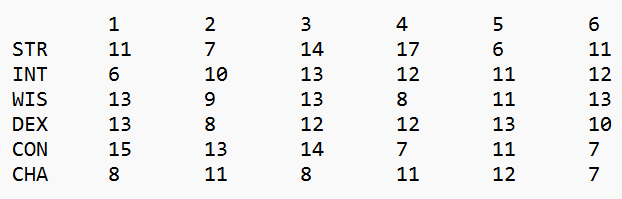
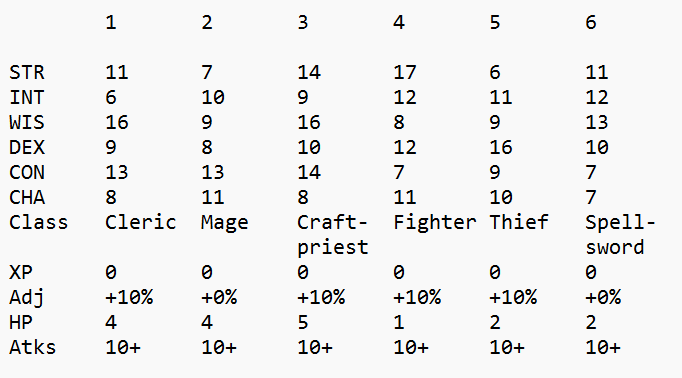
So after rolling up those bad boys it’s time to choose some classes, looks like the standard fare is there (fighter, cleric, thief, and mage) and a pair of dwarven and elven options available here in the main book. Classes have exactly what I’d expect with a prime requisite ability score (with attendant XP bonus for high attribute scores) requirements, HD and max level. So now let’s pick some classes for these fellas and from there I can then sacrifice points from non-prime requisite attributes to raise the prime requisite at a 2:1 ratio (without lowering it below 9). Then roll the starting HP, and get the starting attack & saves for each. It’s at this time the default AC of 0 & attack throw of 10+ jump out at me. This is pretty much not any different from THAC0 20 vs ac 10 requiring a roll of 10 or better on the die. So time to make some choices for that starting party.
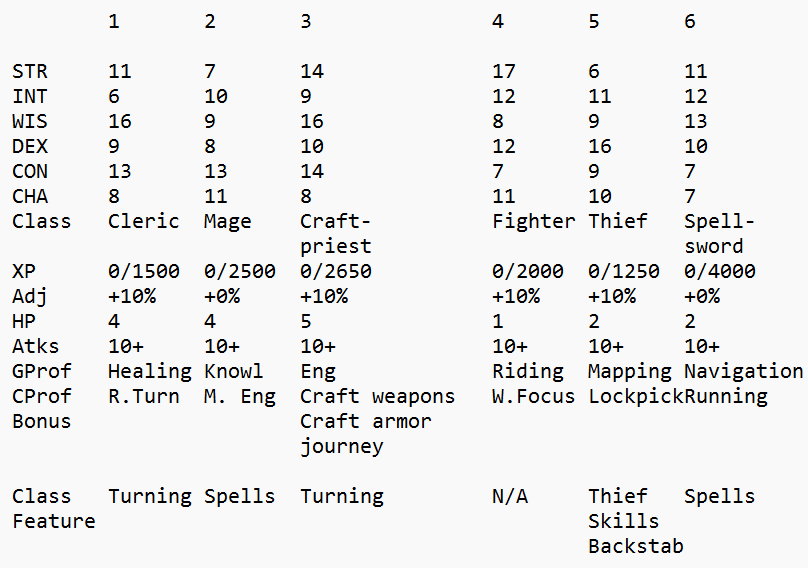
Next up takes us to something else new and interesting here. Proficiencies. Let’s see how that works over in Chapter 4. Ok, so it looks something in between skills and feats with each character getting a general and class proficiency at level 1 and bonus general proficiencies based on int bonuses (Of which I have none. Good work dummy.)
After a bit of time thinking about it and grabbing proficiencies for each of the starting six characters we have something like this. I will say that the book does mention that gear and proficiencies can be time-consuming, and I’d definitely agree that picking a pair of general and class proficiencies did slow down my process, but I imagine that with some more familiarization it’d speed up pretty quickly.
Next up will be equipment and final touches, and getting them transferred from the notepad to character sheets. But that is going to be a task for tomorrow.